
Engine Diagnostics & Repair in Dubai
Warning lights, misfires, power loss and overheating — the cause confirmed with data before any part is replaced
Pick-up and recovery available on request.

Replacing parts until a fault disappears is expensive and often does not work. We read the fault memory, then verify it with live data, measurements and tests on the car: misfire counters per cylinder, fuel trims, oxygen-sensor signals, compression and leak tests. You get the cause, the options and what each one fixes.
Modern engines are controlled by software and sensors, so the same symptom can come from a mechanical part, a wiring fault or a control unit. A structured diagnosis narrows the possibilities step by step and backs every conclusion with a reading or a test. That is how an engineer approaches a fault, and it is how we approach yours.
What’s included
- Full-system fault-code scan with freeze-frame and live data
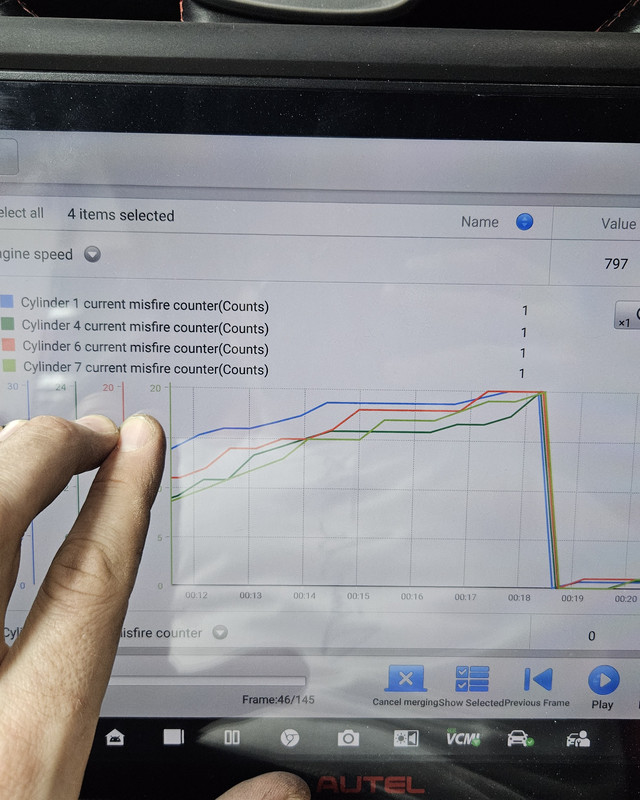
- Misfire diagnosis: per-cylinder misfire counters, coils, plugs, wiring, injectors, compression and fuel delivery
- Injector testing and, where it makes technical and economic sense, ultrasonic cleaning instead of replacement
- Coolant-loss and combustion-gas (block) testing
- Oxygen-sensor and catalyst efficiency analysis from live signals
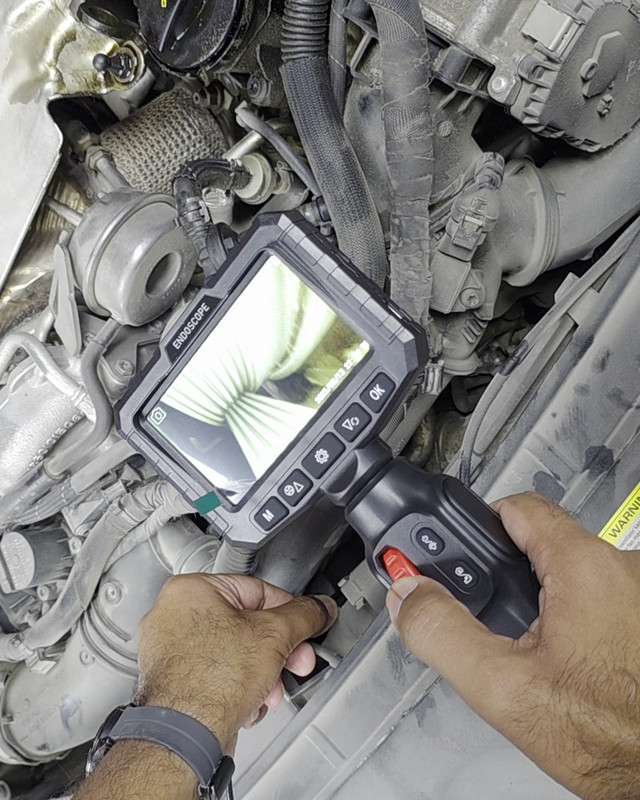
- Vacuum and boost leak testing; borescope inspection of cylinders
- Power loss, rough idle, overheating and warning-light faults
- Oil and coolant leak tracing
- Findings explained with the data on screen, and the repair options priced before work starts
See alsoEngine Overhaul →Transmission Diagnostics & Repair →
A misfire is a symptom — here is how we chain it back
A misfire means one cylinder did not burn its charge properly. The engine control unit sees it as a speed irregularity on the crankshaft and counts it per cylinder — that counter is the first useful piece of evidence, because it tells us where, not just that.
From there the chain is short and testable, and each step is cheap to prove: coil (swap it to another cylinder and see if the misfire follows), spark plug (condition, gap, heat range, fuel or oil fouling), wiring and connector, injector (electrical test, flow and spray pattern, leak-down), compression and leak-down (mechanical damage — valve, ring or gasket), and fuel delivery (pressure and volume under load, filter, pump).
Fuel trims and oxygen-sensor signals tell us whether the cylinder is running lean or rich, which usually decides the order of the tests. Following the chain costs an hour or two; replacing coils, plugs and injectors blindly costs far more and often leaves the fault in place.
The blue liquid: a two-minute test that saves an engine
One of our photos shows a glass tester with a blue fluid on the expansion tank. It is a combustion-leak (block) test: air from above the coolant is drawn through a fluid that reacts to CO₂. If combustion gases are leaking into the cooling system — a failing head gasket, a cracked head or liner — the fluid turns from blue to green or yellow. No colour change, no combustion gases.
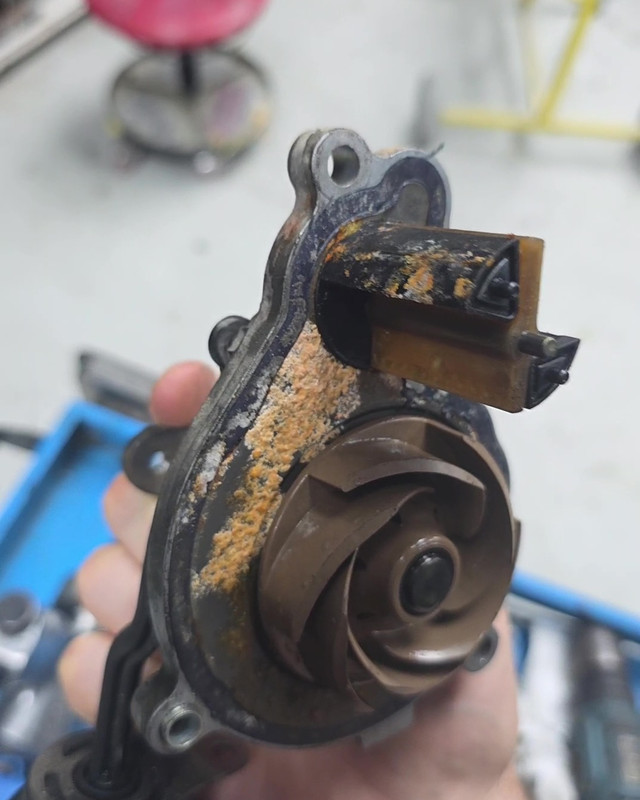
This matters more in Dubai than in most places. A small coolant leak that would be a slow nuisance in a cool climate becomes an overheating event here: coolant level drops, local boiling starts, the head expands beyond its design, and what began as a leaking hose or radiator ends as a burnt head gasket — or a warped head. Fixing a coolant leak early is one of the cheapest repairs on the car; the alternative is on our engine overhaul page.
That is also why we take a temperature warning seriously even when the car “still drives fine”: the damage from overheating is done in minutes, not weeks.
Oxygen sensors: what the live plot actually shows
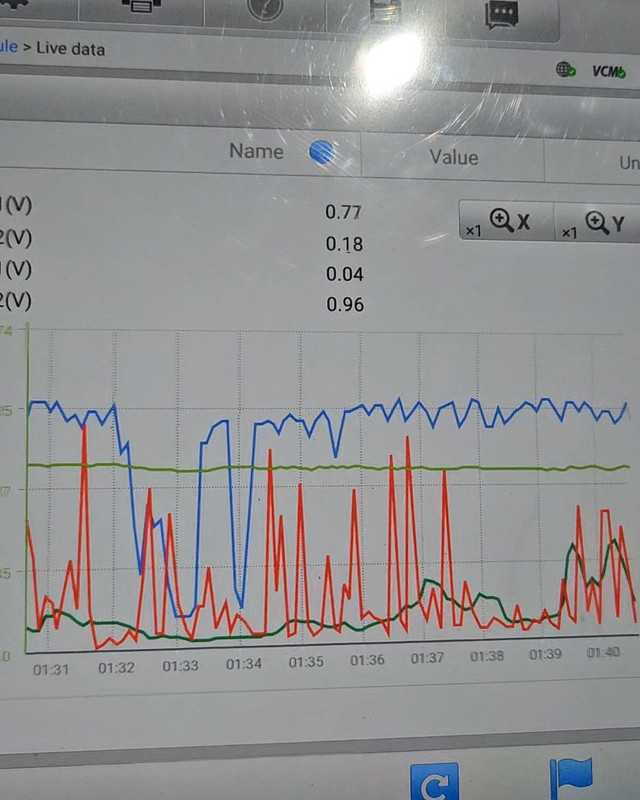
The other screen in the gallery is live oxygen-sensor data. Modern engines have a sensor before the catalytic converter (bank 1 and bank 2, sensor 1) and one after it (sensor 2).
The pre-cat sensor should switch quickly and continuously between rich and lean — a fast, oscillating trace. That is the closed-loop fuel control doing its job. A lazy, slow or flat trace points to the sensor itself, to wiring or to a leak.
The post-cat sensor should be the opposite: nearly flat, because a healthy catalyst buffers the oxygen swings. When the rear trace starts copying the front one, the catalyst is losing efficiency. Reading both traces together is how we separate a failing catalyst from a faulty sensor — two very different repairs that trigger the same warning light.
Our process
- STEP 01 / 04
Read
Full-system fault-code scan and freeze-frame data.
- STEP 02 / 04
Verify
Live data, misfire counters, fuel trims, sensor signals; road test where needed.
- STEP 03 / 04
Test
Component tests: compression, leak-down, block test, injector test, borescope.
- STEP 04 / 04
Explain
Cause, options and cost drivers — before any part is ordered.
How we work on it
Sport, high-end and collector cars — and everyday cars that deserve the same care.
- Data first: no part is replaced on a guess
- Tests, not opinions: compression, leak-down, block test, live signals
- The findings are explained in plain language, with the screen in front of you
From the workshop
Questions
The light is on but the car drives normally. Can I wait?
It depends on the fault. A misfire dumps unburnt fuel into the catalyst and can destroy it; an overheating or oil-pressure warning must stop the car immediately. Send us the code or a photo of the dash and we will tell you which case you are in.
Can injectors be cleaned instead of replaced?
Often yes. We test flow and spray pattern first; if the injector is dirty rather than worn or electrically faulty, ultrasonic cleaning restores it and is a fraction of the cost. If the test says it is finished, we say so.
My coolant level keeps dropping but I see no leak.
That is exactly when we run a combustion-gas test on the coolant and a pressure test. Gases entering the coolant, or a leak that only opens when hot, both show up under test.
Do you clear the code and hand the car back?
No. Clearing a code only removes the message. We fix the cause, then clear, re-scan and road test to confirm the fault does not return.